The Tower
Lightning splits a tower, the crown blows off, figures fall through the air — the Tower is the deck's loudest card, and the one people most dread pulling. Here's what softens it: you usually saw this coming. The crack was in the foundation long before the lightning found it. The Tower just tells the whole truth at once.
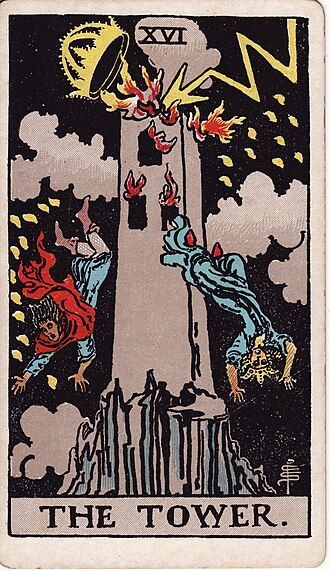
The Tower upright
The Tower is the deck's demolition, and what it brings down was, more often than not, standing on something that couldn't hold. Picture it: a bolt of lightning, a structure coming apart, everything you thought was solid suddenly airborne. Upright, this is sudden change, upheaval, and the collapse of something standing on a false foundation. It's a genuinely hard card, and there's no use pretending otherwise — but hold onto that word, false.
What the Tower destroys is what was never going to hold: the illusion you were maintaining, the structure propped up by denial, the situation that looked stable and wasn't. The lightning is also revelation, a flash that shows you the truth you'd been working not to see. It marks a shock, an unexpected disruption, the floor dropping out from under a thing. It isn't punishment. It's the reality you were avoiding, arriving on its own schedule because you wouldn't call it yourself, and what gets rebuilt afterward stands on ground that's finally real.
The Tower reversed
Upended, the Tower is the collapse resisted, delayed, or narrowly dodged. Sometimes it's the disaster you saw coming and managed to avert or soften — a real near miss, the lesson learned before the whole thing came down. Sometimes it's the harder read: clinging to a crumbling structure, white-knuckling a status quo that's already failing, so afraid of the upheaval that you prolong the slow-motion version of it instead.
The change the upright card delivers in one clean strike, the reversal draws out into a long ache. It can also be an internal upheaval, a private tower coming down where no one else can see it fall. Inverted, the card asks whether you're avoiding a collapse that would ultimately free you, and whether the fear of the crash has started costing more than the crash itself would.
The Tower in love
Where romance is concerned, the Tower is the sudden revelation that changes everything. Upright, it can mark an abrupt breakup, a truth that surfaces and reshapes the whole relationship, or the collapse of a bond that was built on something that wasn't real. It's painful in the moment and, often, clarifying in the aftermath — the illusion falls away and you can finally see what was genuinely there all along.
Reversed, it's the slow-motion version: a relationship visibly failing that both people keep propping up, a revelation avoided, a crisis dragged out because facing it feels worse than enduring it. The Tower in love rarely arrives gently, but it almost never destroys anything that was actually sound. What it takes down was already hollow before the lightning got to it.
The Tower in work and money
At work the Tower is upheaval that shows up without an appointment: the sudden layoff, the restructure, the project that implodes, the professional ground shifting overnight. Upright, it's disruptive and unwelcome, and it usually exposes a structure that was weaker than it looked — the company propped on bad footing, the career built on a role that was never stable to begin with. It clears the way, roughly, for something more honest.
Reversed, it's the collapse deferred: white-knuckling a failing situation, dodging a change that's clearly needed, or narrowly avoiding a professional disaster and getting the wake-up without the wreckage. It's a hard read, but a clean one. What falls in a Tower was already unsound, and what you build next gets to stand on ground you can actually trust.
The relief on the other side
Nobody wants to pull the Tower, so here's the part the dread leaves out. The card that comes right after it in the deck is the Star: hope, healing, renewal, the calm after the storm. That order is not an accident. The Tower breaks the false thing so the true thing finally has room, and what tends to follow a real Tower moment isn't ongoing ruin — it's relief.
The specific, bone-deep relief of no longer having to hold up a lie, protect a doomed situation, or brace for a fall that has at last, mercifully, happened. Plenty of people look back on their Tower moment as the thing that freed them, even when it felt like the end of the world going through it. And when a Tower falls on something that wasn't yours to prevent — a loss that blew in from outside, through no bad foundation of your own — the card's promise narrows to the honest one. Not that you had it coming, but that you can still build the next thing on ground you trust. The card isn't a sentence of catastrophe. It's the collapse of what couldn't last, and the clearing where you get to build on something real. Bad footing was always going to give. The Tower just refuses to let you keep pretending it wouldn't.
At a glance
- Arcana
- Major Arcana
- Number
- XVI
- Element
- Fire
- Keywords
- Sudden Change, Upheaval, Chaos, Revelation