Death
Take a breath. Death is the most misread card in the deck, and it almost never means what the name makes you fear. It's the card of endings, yes, but the working kind — the chapter that's already closed, the version of your life that's already over. You're just still paying rent on it. Death is what happens when you finally hand back the keys.
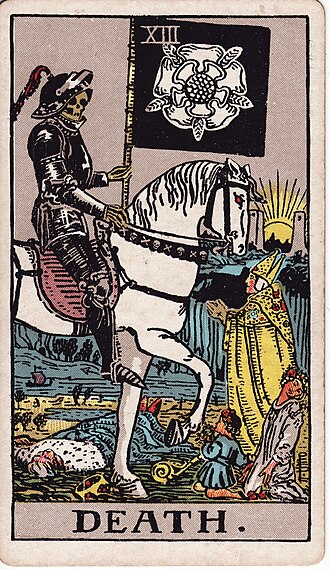
Death upright
Start with what it doesn't mean, because that's almost certainly why you're here: Death almost never points to a literal death, and no serious reader treats it that way. What it marks is transformation — a definite ending that clears the ground for a genuine beginning. Something in your life has run its course: a relationship, a job, an identity, a belief about yourself that no longer fits the person you've become.
Upright, the card's hard kindness is that the ending isn't the disaster; the refusal to let it end is. This is the deck's great card of transition, the clean break that hurts and heals in the same motion. It wants you to stop preserving what's already gone and let the change move through you. What follows Death in the sequence is Temperance — balance, renewal. The ending was never the whole story. It was the doorway.
Death reversed
Here Death is the ending you won't allow. The transformation is knocking and you've barricaded the door: clinging to a relationship that ended emotionally months ago, staying in a role that stopped fitting long back, holding an old self-image together with both hands while it crumbles anyway. This is resistance to a change that's coming regardless, and the reversed card is honest about the cost.
The longer you refuse the ending, the longer you're stranded in the in-between, neither fully in the old life nor free to start the new one. Sometimes the reversed card is a slow, stalled transformation, or a fear of change strong enough to freeze everything in place. The gentle truth underneath it is plain. The thing is already over. You're allowed to grieve it, and then you're allowed to set it down.
Death in love
In love Death is transformation, and it takes some nerve to draw. Upright, it can mark the honest end of a relationship — not a tragedy, but a completion, the recognition that a bond has run its course and that holding on only stretches out the ache. It can also mean a deep change within a relationship: an old dynamic dying so a truer one can grow, a shedding of who the two of you used to be.
Reversed, it's the refusal: staying in something clearly finished, unable to move on, keeping a dead relationship on life support out of fear of the empty space that comes after. Death in love is never comfortable, but it's rarely cruel. It clears room for something you can't reach while your hands are still full of what's already gone.
Death in work and money
Career-wise, Death is the chapter that ends so the next one can start. Upright, it's a job ending, a career transition, a role or an industry you've outgrown, or the deliberate closing of a project that has clearly served its time. The job ending rarely earns the dread it gets on the day. It clears the room so the next thing has somewhere to arrive, and it favors people who let a professional identity change instead of clutching one past its expiry.
Reversed, it's clinging: staying in a dead-end position out of fear, resisting an industry change that's already underway, or refusing to close a project everyone else can see is finished. The card doesn't forecast a specific outcome for your job. It describes a doorway, and it asks whether you'll walk through the ending or keep guarding a door that's already been opened for you.
If the name scared you
If you pulled this card and your stomach dropped, you're in good company, and you can let the fear go. Across countless readings, the Death card overwhelmingly points to endings of the ordinary kind: a move, a breakup, a career shift, the quiet passing of an old habit or belief. Serious readers don't take it as physical death, and neither should you.
What the card actually offers turns out to be oddly hopeful once the name stops shouting. It says something in your life is ready to complete, that you have the strength to let it, and that a real beginning waits on the far side of the ending you've been dreading. The most feared card in the deck is, underneath, about renewal. It only insists that renewal has a price, and the price is letting the finished thing be finished.
At a glance
- Arcana
- Major Arcana
- Number
- XIII
- Element
- Water
- Keywords
- Endings, Change, Transformation, Transition